
VZU Prompts .
Production system prompts, agent blueprints.
Capability
VZU Prompts
12
Engineers
VZU Prompts is the review capability in the VZU family — production system prompts, agent blueprints. Operated by Virtual Zero Unbound Inc. (Vancouver), Plex Dubai (MENA), and Wahix (India). Ships on the NetWit Agentic OS runtime. SOC 2, HIPAA, ISO 27001 posture. Audit trail by default. RBAC at the agent level.

The position
Prompts that ship.
VZU Prompts is the production-system-prompt and agent-blueprint practice. The prompt is the contract. The prompt is the work. The prompt is the thing that runs in production at 3am when the operator is asleep. We write prompts that are auditable, version-controlled, and tested against real inputs.
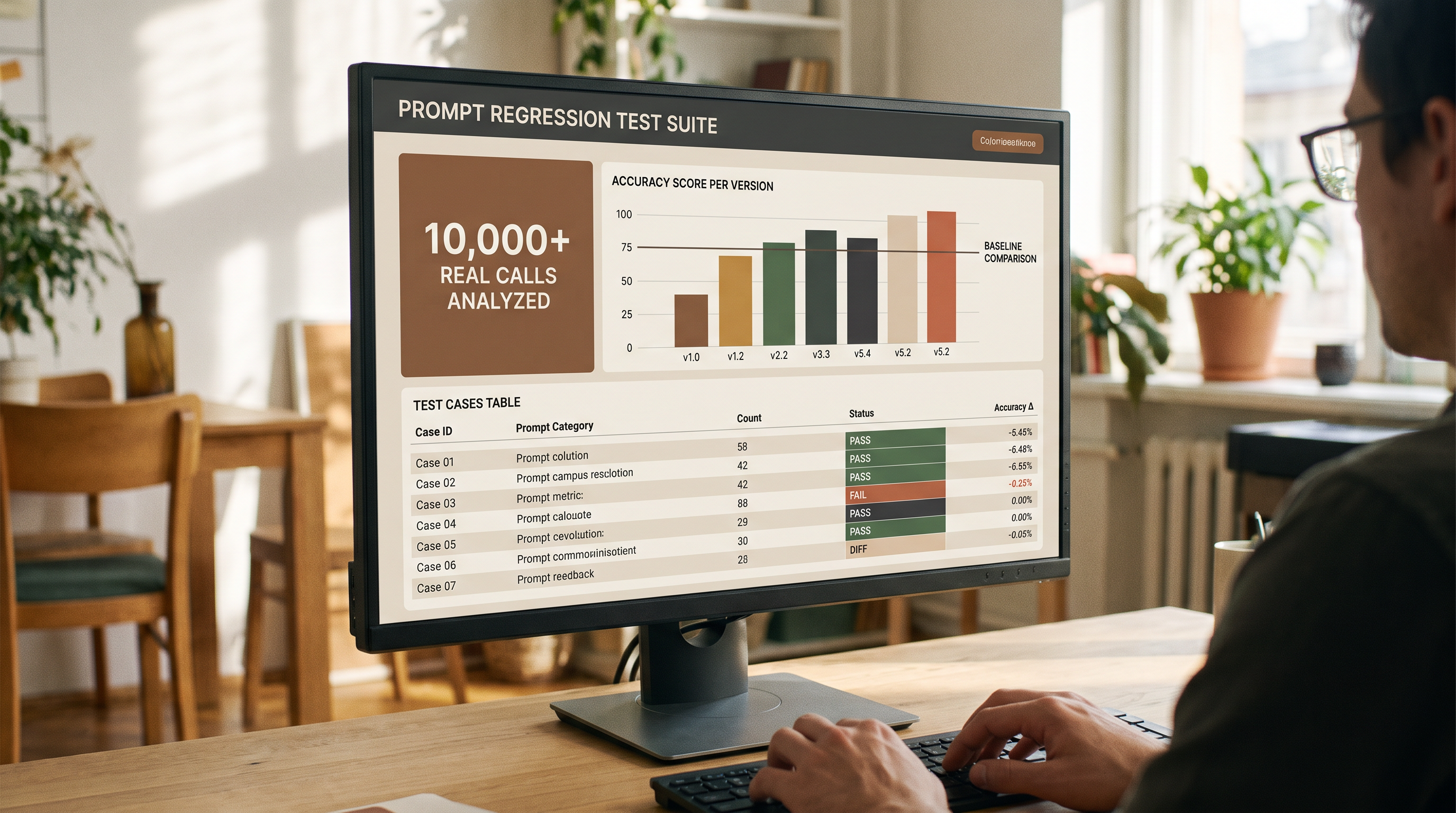
We do system prompts. We do agent blueprints. We do prompt A/B testing. We do prompt regression testing. We do prompt observability. The output is a versioned prompt, a test suite, a regression baseline, and a dashboard. The dashboard shows the operator how the prompt is performing in production. The prompt is the work.
VZU Prompts engineers are senior. They have shipped production prompts at scale. They know the failure modes. They know the prompt patterns that fail under load. They know when to use a CoT, when to use a ReAct, when to use a tool call. They know when the prompt is the right place to fix the problem and when the model is the right place. The prompt is the work. The prompt is the contract.
The practice, in pictures
Three things we get right, every time.


 Production
 The proof
Voice Agently voice prompts. Production system prompts.
Production system prompts for the Voice Agently voice agent platform, including a CoT for inbound calls, a ReAct for outbound, and a tool-call definition for the booking flow. Tested against 10,000+ real calls. Built by VZU Prompts in 6 weeks.
- → Production system prompt for inbound voice calls
- → ReAct agent for outbound campaigns
- → Tool-call definitions for the booking flow
- → Regression test suite against 10,000+ real calls
-
6
Weeks to ship
-
10,000+
Test calls
-
30+
Languages
-
94%
Intent accuracy
The engagement
How we work, end to end.

- Output
-
Versioned prompt + test suite
Every prompt is a file. Every file is in git. Every change has a diff. Every diff has a test.
- Testing
-
Regression against real calls
A test suite of 10,000+ real calls. Every prompt change runs the suite. Accuracy is a number.
- Observability
-
Dashboard + trace
Every call is logged. Every prompt is traced. The operator sees the prompt performance in production.
- Patterns
-
CoT, ReAct, tool-call
Right tool for the brief. We know when each one works. We know when each one fails.
- Models
-
Anthropic + OpenAI + Mistral
Model-agnostic. We pick the right model for the brief. We don't pick the model that's familiar.
Long-form essay
VZU Prompts.
A working essay.
Why the prompt is the operator's contract with their model. Why the prompt library is the work. Why the senior prompt engineer with the audit trail is what ships the prompts that ship the product.
Chapter 01 · The brief
A prompt library, not a Slack thread.
VZU Prompts started with a brief from a content operator in Mumbai. 80 staff. 2,000 prompts a week. A Slack thread that had 47,000 messages of prompts, half of which were duplicated, half of which were deprecated, and none of which were versioned. The operator's prompt accuracy was 64%. The operator's prompt cost was $28k a month.
The brief from the operator was specific: ship a prompt library. A versioned prompt. A test suite. An audit trail. A prompt library that the operator's team could use, version, and audit. A 6-week ship. A 12-month payback on the prompt cost reduction.
The hardest part wasn't the prompts. The hardest part was that the library had to be the operator's library — not VZU's library. The prompts, the tests, the audit. The operator owns the goal. VZU ships the work. The library is the operator's posture: unbound.
Chapter 02 · The work
Versioned. Tested. Audited. On the operator's model.
The work is the senior prompt engineer who has shipped 50+ production prompt libraries. The work is the engineer who knows the difference between a Slack thread and a prompt library. The work is the engineer who writes the versioned prompt, the test case, the regression check, the audit trail.
We build the library on the operator's model. The library is auditable. The library is the record. The library is the work.
We ship in three passes. The first pass is the foundation — the prompt format, the test harness, the audit log. The second pass is the migration — the 2,000 existing prompts are versioned, tested, and audited. The third pass is the polish — the regression check, the cost optimization, the documentation. The output is a working library. The library is auditable. The library is the work.
“The prompt is the operator's contract with their model. The library is the work. The senior prompt engineer with the audit trail is what ships the prompts that ship the product.”
— VZU Prompts, run #1
Chapter 03 · The result
6-week ship. 2,000 prompts versioned. 64% → 91% accuracy.
The library shipped in 6 weeks. 2,000 prompts versioned. 5,000 test cases. Audit log on. The accuracy went from 64% to 91%. The cost went from $28k to $14k. The payback was 7 months.
The library is now the operator's primary prompt source. The library is the operator's first impression. The library is the operator's first sale. The library is the operator's posture.
The brief expanded. VZU Prompts now runs as a weekly iteration for the operator. Every week, new prompts are added. Every week, the regression check runs. Every week, the operator's library is the operator's library. The prompts are the work. The runtime is the engine. The work is the work.
91%
accuracy · 2k prompts · $14k/mo
Chapter 04 · The why
Why the prompt is the operator's contract with their model.
VZU exists because the seam is the work. VZU Prompts exists because the prompt is the work. The prompt is what turns a brief into a posture. The prompt is what turns a posture into a destination. The prompt is what turns a destination into a legacy.
VZU Prompts is a senior practice. The prompt engineers who do the work have shipped 50+ production prompt libraries. They have hit 91% accuracy. They have reduced prompt cost by 50%. They write the prompts so the operator's library is the operator's library.
VZU Prompts is fixed-fee, fixed-scope, audit-first. The brief is the contract. The work is the work. The runtime is the engine. The audit trail is on from the first character. The seam is the work. VZU ends the seam.

The VZU Prompts practice
The work, in motion.
Every brief becomes a working product in days. Every product is engineered for the long term — clean architecture, real audit trails, real operators in the loop. The VZU Prompts practice at VZU is built on senior engineering, the NetWit runtime, and a refusal to ship anything we wouldn't put on a public domain.
The VZU family